

Pothole-Related Road Accidents: A Growing Safety Concern
Look, out on the streets, the asphalt isn’t your friend—it’s a battlefield. Potholes, hidden speed breakers, invisible dividers, and missing drain covers are active hazards waiting to take you down. If you want to ride hard and make it home in one piece, you don’t rely on luck. You rely on prep, gear, and elite road discipline.
Here is your master plan to bulletproof your ride against broken infrastructure.
When a hidden pothole launches you, your clothing is your last line of defense. Dress for the slide, not the ride.
You need impact-absorbing armor (CE Level 2) on your shoulders, elbows, knees, and hips to cushion the blow if a crater throws you off balance.
An open-face helmet will not protect your jaw if you hit an unpainted speed bump at night and go over the handlebars. Get an ISI, ECE or Snell-certified lid.
Hitting a deep pothole can violently compress your foot against the pegs. You need ankle support and steel shanks to prevent fractures.
The first thing that hits the tarmac when you lose control is your hands. Look for palm sliders to let your hands skid instead of snapping your wrists.
Stock bikes are built for perfect showroom floors. If your daily commute looks like an off-road course, you need to modify your machine.
Factory headlights are notoriously bad at showing road texture. Mount low-angled, high-intensity aux lights. They cast long shadows into potholes and open drains, making them visible from hundreds of feet away.
A deep crater or an unmarked concrete divider can instantly crack your engine case or bend your exhaust frame. Install heavy-duty frame sliders and an aluminium bash plate underneath.
Hard impacts with road hazards cause slow leaks or instant rim bends. A digital TPMS on your handlebars warns you the second your pressure drops.
Make your bike visible to others when you have to slam on the brakes unexpectedly for a road hazard.
Road Accident Fatalities: A Growing Safety Concern
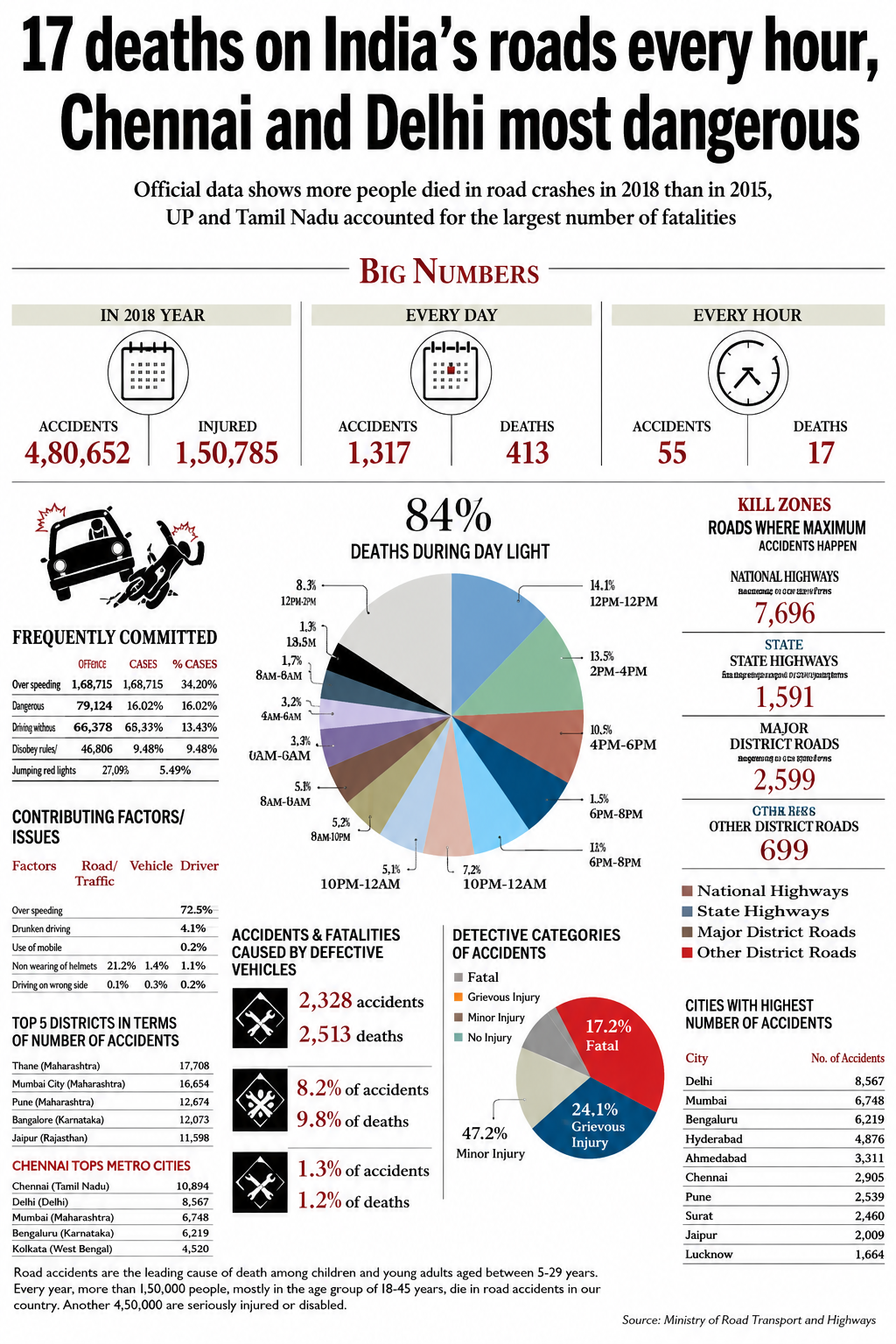
Road accidents continue to be a major public-safety challenge in India, with fatalities showing a worrying upward trend in recent years. According to the Ministry of Road Transport & Highways, road accident deaths increased from approximately 1.38 lakh in 2020 to 1.73 lakh in 2023. These figures highlight the importance of proactive road-safety measures, including better hazard visibility, timely identification of accident-prone areas, effective warning systems and safer road infrastructure. Lionex is committed to supporting these safety efforts by providing reliable road-safety solutions that help improve visibility, alert road users to potential hazards and contribute to safer roads for everyone.
Source – Ministry of Road Transport
Hardware means nothing without elite tracking and reaction time. Treat the road like a moving puzzle.
Never stare directly in front of your front tire. Look 15–20 meters ahead. Scan for shadows, sudden breaks in the asphalt pattern, or vehicles ahead swerving unexpectedly.
Watch the cars in front. If a car’s suspension suddenly dips or bounces, they just hit a pothole or a speed bump. Memorize that spot and steer clear. Also, track brake-lights ahead of you, if the car or the Biker ahead of you braked, take clue from what you see and adjust accordingly.
Riding close behind a bus or truck blindingly traps you. If they pass cleanly over an open drain cover or crater because of their high ground clearance, it will appear out of nowhere right under your front wheel.
If you must cross a broken lane divider or lip, attack it at a sharp angle so your tire doesn’t get caught in the groove. For speed bumps, approach dead-straight; hitting a bump at an angle unbalances your chassis.
If hitting a massive pothole or speed breaker is 100% unavoidable, do not brake through the impact. Brake hard before the hazard, release the brakes right before impact to let the suspension travel freely, stand up slightly off the seat, and let your legs act as secondary shock absorbers.

Engineered for multi-day bikepacking, alpine gravel passes, and off-grid touring. We manufacture ultra-durable lights, thermal gloves, weatherproof backpacks, MIPS helmets, and titanium mounts built for extreme conditions.
© 2026 LIONEX®. All rights reserved.
Designed and Developed by Easy Solutions 360.
Please select a template first

Added to cart
Check out our shop to see what's available